

Ford Super Duty Dually Guide: F-350, F-450, F-550, F-650 & F-750 Explained

Which Dually Model Is Right for You?
Buyers often see similar Ford badges and assume the trucks differ only by size, but the real differences are in ratings, frames, axle limits, and intended job type. Whether you’re comparing a Ford F-350 dually, Ford F-450 dually, Ford F-550 dually, Ford F-650 dually, or Ford F-750 dually, the useful question is not which truck sounds toughest, but which one matches your trailer, payload, upfit, and legal operating limits. This Ford Super Duty dually guide focuses on real workload decisions, from pickup towing with available electronic shift-on-the-fly 4WD to vocational body planning on medium-duty trucks. Understanding the differences between these dually models can help you choose the right truck from RC Lacy Ford for your business, fleet, or heavy-duty towing needs.
What You’ll Learn in This Guide
Our Ford Super Duty dually guide explains how dual rear wheels improve stability, payload handling, and towing confidence, especially with tall trailers, heavy pin weight, or commercial cargo. You’ll also see how to compare a Ford F-350 dually, Ford F-450 dually, Ford F-550 dually, Ford F-650 dually, and Ford F-750 dually based on trailer type, upfit needs, ratings, and real-world workload.
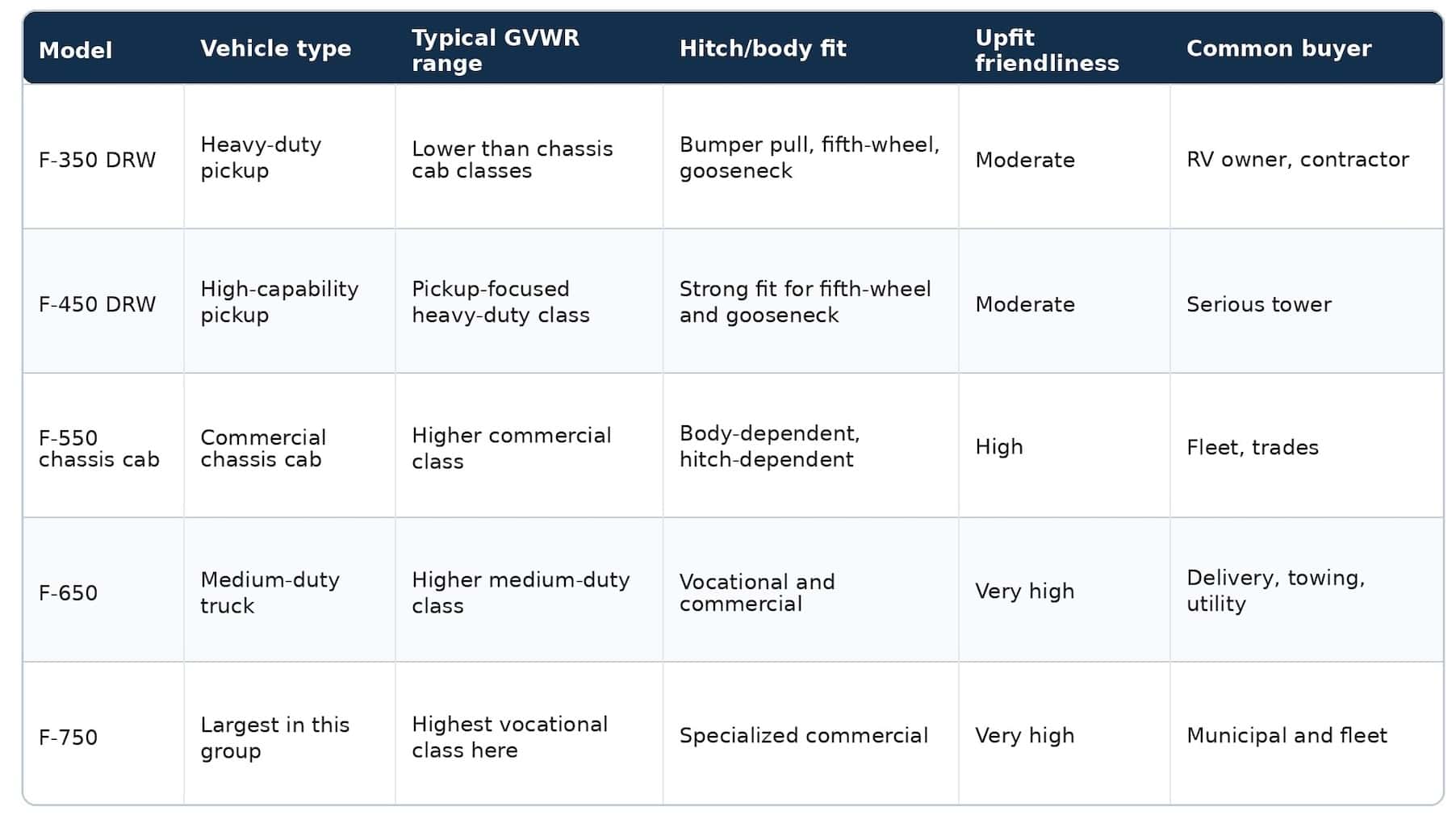
Quick Comparison Table
What Is a Dually Truck?
A dually, also called a DRW or dual-rear-wheel truck, has two rear tires on each side of the rear axle. That extra rear tire capacity helps manage heavy loads, commercial bodies, and large trailers that can push a single-rear-wheel truck past its practical limits.
Why Choose a Dually Over a Single-Rear-Wheel Truck?
A dually can feel more stable with a fifth-wheel RV, gooseneck trailer, equipment trailer, or loaded service body because the wider rear footprint helps resist sway and side-to-side movement. Features like trailer sway control, available towing technology, and driver-assist camera views can add confidence, but the biggest advantage is how a DRW truck manages rear-axle stress under serious load. The tradeoffs matter, too. Dually trucks are wider, cost more to tire, fit fewer parking spaces, and may feel less forgiving on slick roads when unloaded.
Overview of the Ford Super Duty Dually Lineup
The Ford Super Duty lineup moves from pickup-based heavy towing to upfit-ready chassis cabs and medium-duty commercial trucks. The right choice depends less on badge size and more on GVWR, GAWR, payload, hitch type, body style, and how the truck will be used every day.
A Ford F-350 dually is often the best fit for drivers who want strong towing capability with a traditional pickup bed. A Ford F-450 dually adds more control margin for large fifth-wheel RVs, gooseneck trailers, and frequent heavy towing. A Ford F-550 dually is built for commercial upfits, including flatbeds, dump bodies, utility bodies, and service trucks. A Ford F-650 dually moves into medium-duty territory for larger bodies, regional delivery, towing, and utility work. A Ford F-750 dually is Ford’s largest Super Duty work truck, built for demanding vocational roles, fleet use, and specialized commercial applications.

Capability Basics to Know Before You Compare
Before choosing between a Ford F-350 dually, Ford F-450 dually, Ford F-550 dually, Ford F-650 dually, or Ford F-750 dually, focus on the numbers that actually control the job. GVWR is the truck’s maximum allowed weight, GAWR limits each axle, payload is what the truck can carry, and GCWR is the maximum combined weight of truck and trailer. Payload is reduced by passengers, fuel, tools, hitch hardware, accessories, and upfit equipment. Rear GAWR is especially important for fifth-wheel and gooseneck towing because pin weight lands near the rear axle, which is often where buyers hit their first hard limit.
Trailer Types: Bumper Pull, Gooseneck, and Fifth-Wheel
Bumper-pull trailers place tongue weight behind the axle, which can increase leverage and sway if the trailer is long or improperly loaded. Gooseneck and fifth-wheel trailers distribute weight in the bed for better stability, but they also use up payload faster. That is why many buyers run out of rear-axle or payload capacity before reaching a truck’s advertised max tow rating.
Ford F-350 Dually: Everyday Heavy-Duty Capability
The Ford F-350 dually is a strong starting point for buyers who tow often but still want pickup-bed flexibility. It works well for fifth-wheel campers, horse trailers, equipment trailers, ranch use, and small-business hauling. For many owners, the Ford F-350 dually is the most balanced choice because it combines serious DRW stability with everyday usability.
Ford F-450 Dually: Maximum Pickup-Style Towing
The Ford F-450 dually is designed for drivers who tow large trailers often and want more control, braking confidence, and stability. It is a strong match for large RVs, heavy gooseneck trailers, multi-car trailers, and frequent mountain towing. Buyers should still confirm the door-sticker payload, as pin weight, passengers, fuel, and cargo all affect real-world capacity.
Ford F-550 Dually: Commercial Chassis Cab Strength
The Ford F-550 dually is built around the job, not just the trailer. As a chassis cab, it can be configured with flatbeds, dump bodies, landscape bodies, tow equipment, utility bodies, cranes, compressors, and other vocational upfits. It is often the right choice for contractors, landscapers, municipalities, utilities, and mobile service businesses that need a truck to carry equipment and tow in the same workday.
Ford F-650 Dually: Medium-Duty Work Capacity
The Ford F-650 dually steps beyond pickup-style thinking into medium-duty commercial use. It is commonly chosen for box trucks, tow trucks, beverage delivery bodies, larger utility builds, and regional fleet work. For businesses that repeatedly max out smaller trucks, the Ford F-650 dually can offer the durability, body capacity, and serviceability needed for higher-demand routes.
Ford F-750 Dually: Ford’s Largest Super Duty Work Truck
The Ford F-750 dually is built for serious vocational demands, specialized bodies, and high-utilization fleets. Common configurations include large dump trucks, rollback carriers, fire and rescue units, and heavy commercial bodies. This truck makes the most sense when the work consistently requires its size, ratings, and commercial capability.
How to Choose the Right Ford Super Duty Dually
Start with your trailer’s real loaded weight, not its brochure number. Then calculate passengers, fuel, tools, cargo, hitch weight, tongue weight, pin weight, and any upfit equipment. Match those numbers to GVWR, GAWR, GCWR, payload, hitch rating, tire rating, and wheel rating before choosing a truck. For many RV owners, a Ford F-350 dually works well, while a Ford F-450 dually adds confidence for larger fifth-wheels or frequent heavy towing. For contractors and owner-operators, a Ford F-550 dually often makes sense when a working body is part of the job. For fleets, a Ford F-650 dually or Ford F-750 dually may be the smarter long-term choice when uptime, body capacity, and vocational durability matter most.
Common Mistakes to Avoid
The biggest mistake when shopping for a Ford Super Duty model is shopping based solely on max tow rating. A truck can have enough power to pull a trailer and still be overloaded at the axle, tires, wheels, or the hitch or payload limit. Whether you choose a Ford F-350 dually, Ford F-450 dually, Ford F-550 dually, Ford F-650 dually, or Ford F-750 dually, the best choice is the one that matches the job safely, legally, and confidently.
Find Your Dually
Choosing between a Ford F-350 dually, Ford F-450 dually, Ford F-550 dually, Ford F-650 dually, and Ford F-750 dually comes down to matching the truck to the work you need it to do. Whether you’re towing a large RV, hauling equipment to the jobsite, managing a fleet, or planning a specialized commercial upfit, understanding payload, towing capacity, axle ratings, and intended use will help you make a confident decision. If you’re ready to compare models in person or need help finding the right Ford Super Duty dually for your needs, visit RC Lacy Ford. Our team can walk you through the differences between each Ford Super Duty dually model, review your towing or business requirements, and help you find a truck built to handle the demands of your workload.
FAQs
Is the Ford F-450 Always a Dually?
In consumer pickup form, the Ford F-450 is typically a DRW truck, but buyers should still verify the exact configuration and market. The key distinction is its towing-oriented hardware, not just the badge.
Can You Daily Drive a Dually Truck?
Yes, but daily use means living with extra width, higher tire cost, and tighter parking options. The tradeoff is much better stability when the truck is actually working.
What Is the Difference Between a Ford F-550 and a Ford F-650?
The Ford F-550 is a Super Duty chassis cab designed around upfits and heavy commercial work. The Ford F-650 is a medium-duty truck with higher GVWR options and a stronger fit for larger bodies and harder daily cycles.
Which Ford Dually Has the Highest Towing Capacity?
Towing capacity depends on configuration, hitch type, axle ratio, and GCWR, so there is no single universal winner across every setup. Use the official Ford towing guide and your truck’s labels for the exact answer.
Do You Need a CDL to Drive a Ford F-650 or F-750?
Sometimes, because CDL rules depend on GVWR, GCWR, trailer weight, and local law. Confirm requirements with your DMV, employer, and insurer before ordering the truck.
What tows more, Ford F-450 or Ford F-550?
It depends on the configuration and hitch type. The Ford F-450 is often optimized for very high towing capacity, while a Ford F-550 can vary widely depending on body weight, axle ratio, and GCWR.
How much can a Ford F-550 legally tow?
Legal towing depends on the truck’s GCWR, hitch rating, trailer brake setup, and local regulations. Use the exact VIN-based ratings and confirm operating rules with your local DMV.